Our Products
Murica 150 MS
Murica 150 MS
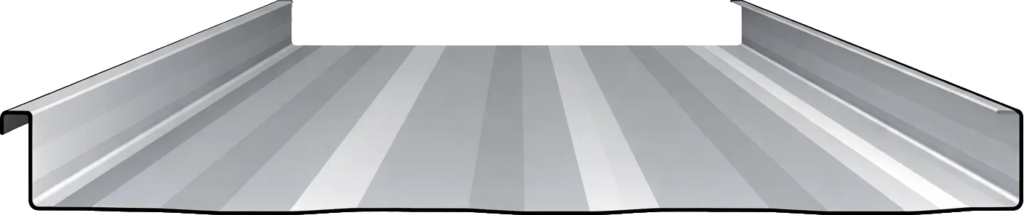
The Murica 150 MS is a 1 1/2″ mechanical standing seam panel engineered for serious durability and precision performance. Built for residential and commercial projects across Florida, it delivers reliable strength under extreme weather, thermal movement, and structural demands.
Available in 90° or 180° seams and in 24 Galvalume®, 0.320 Aluminum, and Copper 16oz options, the Murica 150 MS features a 16″ panel coverage and curve-capable configurations. Engineered for applications with a minimum slope of 1:12 and uplift pressure up to -218.8psf, tested to meet Florida Building Code, HVHZ, and Miami-Dade requirements, this panel is mission ready for contractors who demand the best.
PERFORMANCE TESTING
Our metal roofing systems are engineered and tested to perform under the most
demanding conditions. The Murica 150 MS is Florida Product Approved for both HVHZ and non-HVHZ applications, delivering proven strength, reliability, and confidence where it matters most. With a maximum uplift pressure of -218.8psf, it is undeniably victorious in the metal roofing industry.
| Testing Category | Certification & Standard |
|---|---|
| Uplift Resistance | UL 580, UL 1897, TAS 125, TAS 110 |
| Wind-Driven Rain | TAS 100 |
| Tensile Strength | ASTM E8 |
| Fire Rating | UL 790 |
| Salt Spray - Coating | ASTM B117 |

Murica 150 MS Features
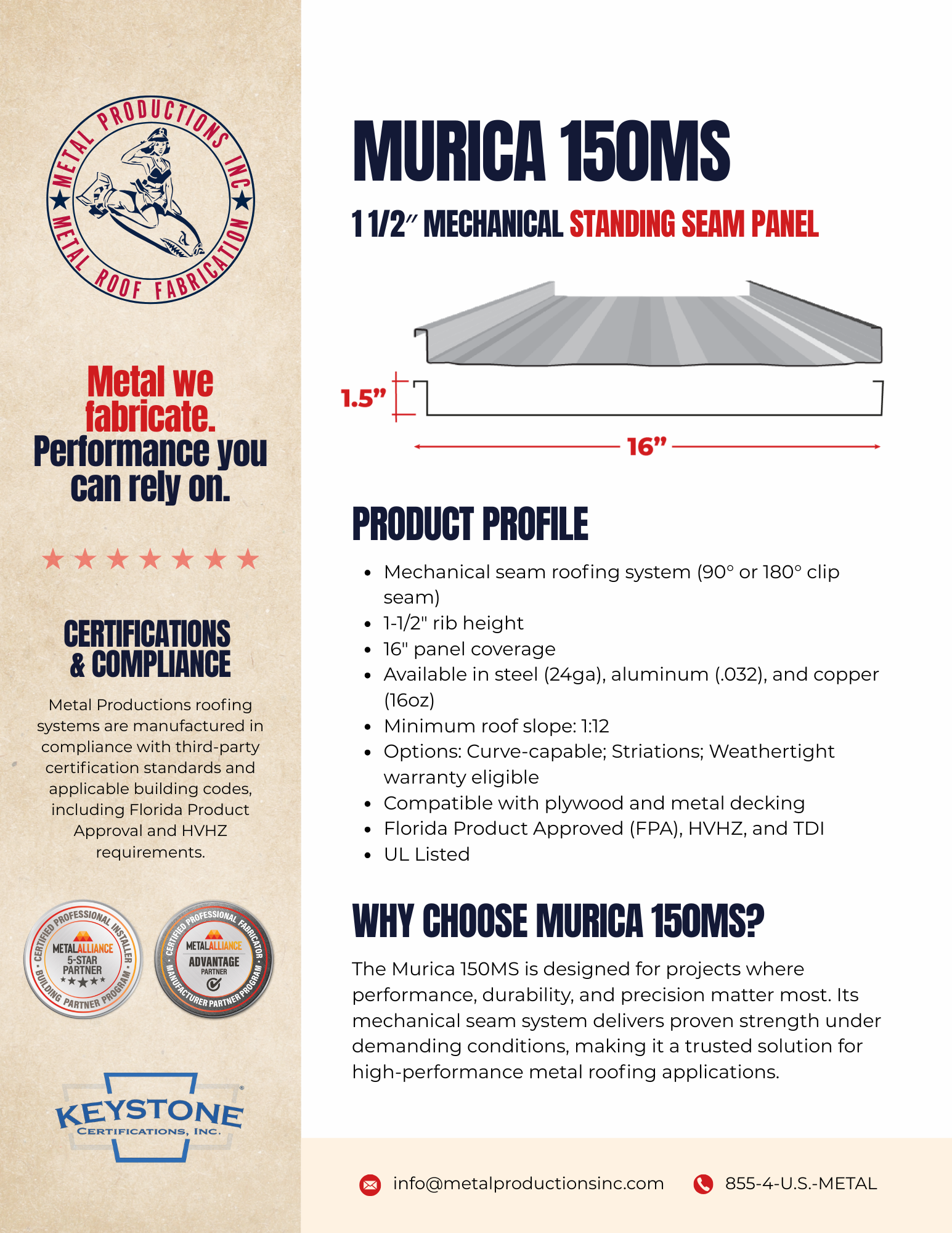
- 1-1/2" mechanical standing seam system designed for residential and commercial applications
- Heavy-gauge construction built for long-term durability and demanding environments
- Mechanically seamed concealed fastener system for clean lines and secure interlocking performance
- Curve-capable design suitable for radius and custom architectural conditions
- Seam options available in 90° or 180°, depending on project requirements
- Custom panel lengths fabricated to match each job
- Backed by long-term material and finish warranties
Specifications
- Clip: 24 GA – 2 inch
- Rib Height: 1-1/2"
- Panel Coverage: 16"
- Material:
- Steel (24ga)
- Aluminum (.032)
- Copper (16oz)
- Minimum Slope: 1:12
- Support: Plywood, Metal Decking
- Product Approvals: FPA, HVHZ, TDI
- UL Listed
- Options:
- Curve-Capable
- Striations
- Weathertight Warranty Eligible
1 1/2" Mechanical Seam Metal Roof Packages
Installation Services
Custom Metal Fabrication
Turnkey Solutions
Complete Customer Support
Frequently asked Questions
Metal roofing typically has a higher upfront cost than asphalt shingles, and cement tiles, but the long-term value is unmatched. With superior durability, minimal maintenance, and excellent energy performance, metal systems often deliver a lower total cost of ownership, especially in demanding climates like South Florida.
Metal roofs require very little maintenance. Routine inspections and occasional cleaning to remove debris are usually all that’s needed. Keeping gutters and drainage paths clear is especially important, helping ensure optimal performance and extending the lifespan of
the roofing system.
Yes. Metal roofing is one of the most sustainable options available. Many systems are made with recycled content and are fully recyclable at the end of their life. Their reflective properties reduce heat absorption, improving energy efficiency and lowering cooling demands. It’s an advantage for both the environment and long-term operating costs.
A properly installed metal roof can last 40–70 years or more, depending on material and environmental conditions. This exceptional lifespan is one of the key reasons metal roofing is trusted in high-wind and hurricane-prone regions.
Yes, the initial investment is typically higher. However, when you factor in longevity, durability, reduced maintenance, and better energy performance, metal roofing often becomes the more cost-effective solution over the full life of the building.
No. Metal roofs do not attract lightning. They are no more likely to be struck than roofs made from other materials. In the rare event of a strike, a metal roof can safely dissipate the electrical charge when properly grounded, just like other code-compliant systems.
Modern metal roofing is engineered to resist corrosion. Materials such as galvanized steel, Galvalume®, and aluminum include
advanced protective coatings designed to withstand harsh environments. Our systems use industry-leading finishes, including Sherwin-Williams Fluorpon, along with American-made metals for long-term performance and durability.
No. Metal roofs often help reduce heat gain. Metal roofs do not hold on to radiant heat like asphalt shingles or cement tile. Metal
instantly cools off when not in direct sunlight. Their reflective surfaces deflect solar radiation, and many coatings are engineered to enhance thermal performance. This can result in cooler interiors and lower energy costs during peak summer temperatures.